Sunday, November 21, 2010

Out of the Oven

Here is the joint out of the oven. It sat at 200F for 2 hours after ramping up for 30 minutes. The bag, release ply etc peeled off fairly clean but I'll use some flash break tape next time to keep the tubes clean in the first place. You can see in the photo below I had some bag pressure issues. A small hole developed right at the inlet tube and the pressure was 15-20inHg (or about 10pis) when I it took it out of the oven. The shiny area is where the release ply was not being pressed into the joint.

On the top side though, the joint is well compacted and solid. I found that tapping on the joints tells you a lot. You can tell the uncompressed areas by sound alone.


While not pretty yet (these are un-sanded) and not fully compacted the main tube joints feel strong and stiff. Destructive testing and cutting it apart will tell the whole story though.

Joint Test Vacuum Bag

Here is a BB test joint I've prepped for the oven. I used 3 pieces of Stretchlon 250 bag material and 350F rated bag tape. Under the tape is release cloth with a very fine weave, then the carbon prepreg layers. You can see the UHMW plugs I use in the BB to run the bag and seal tape onto.


It took about 10 minutes to get all the leaks sealed and I was able to pull 26mmHg on the pump. The bag did it's job and stretched nicely into the fillets. The release cloth appears to be enough of a bleed layer on a bag this small, everything was pulled down tight.

Friday, November 05, 2010

Head Tube Cure and Finish

After applying 10 layers on the mandrel I used the lathe to hold the it in place and slowly turned it by hand to apply the release coated shrink tape. I'm carefully overlapping 75% with the previous turn for better compressive force and a smoother ridge free finish.

Into the oven it goes...


Here it is straight out of the oven with the shrink tape removed. Notice the left hand end, that's where the masking tape holding the shrink tape in place let go and allowed it to slip. Good thing I made the tube a little longer than required.


Back in the lathe I hand wet sand the outer surface and square the ends with the lathe tooling. Wet sanding eliminates the dust issue (as long as you protect the lathe from the splashing).


The finished headtube. It is ridiculously stiff and weighs 50.3 g.

Head Tube Layup

After calculating the thermal expansion of UHMW for the temperature delta of the cure process I decided to layup a headtube for Chris King InSet headset press fit ID of 44mm.

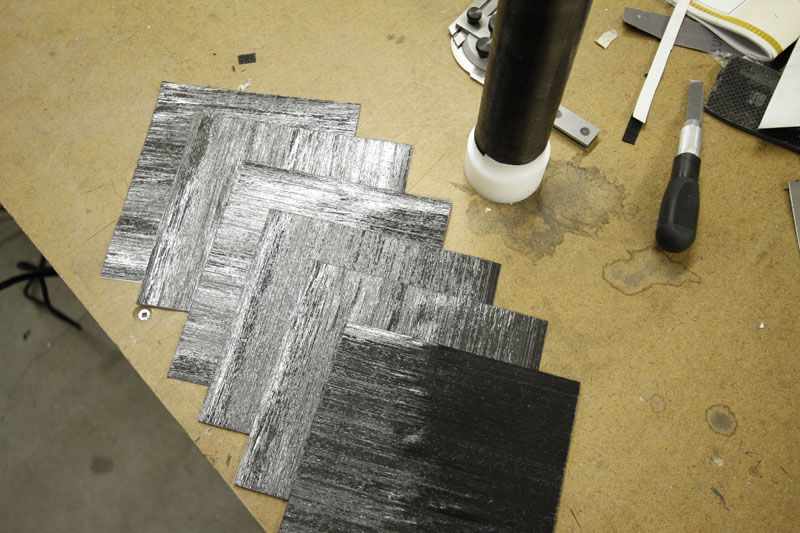
You can see the layers below, 10 in total, alternating between 0 deg and 90 deg.


The next two photos show the wrapping process as the carbon sticks to the previous layer and the backer is peeled away. Working in the shop around 50F I had to use a heat gun to increase the tack level of the prepreg in order to get the wraps to stick and conform.


The finished layup ready to shrink tape.

Thursday, October 07, 2010

Tube ID

The tube ID turned out nicely. The fine groove from turning on the lathe was clearly reproduced as well. It will need more layers to be an effective BB shell tube. This process may even work for custom layup frame tubes as well.

Press30 Tube

Here is the finished tube (test) for a Press30 BB. I need to adjust the mandrel OD to account for the thermal expansion of the UHMW but other than that, the process worked as planned. I might even be able to use 90deg fibers and not have it stick to the mandrel.

UHMW Mandrel


I tried unsuccessfully to lay up a head tube on a turned polished aluminum mandrel. Even with 3 layers of high temp release wax, post cure the carbon would NOT come off the mandrel. Back to the drawing board. Next I conducted a test using UHMW as a mandrel. It has a higher coefficient of thermal expansion than aluminum and nothing sticks to it (at least not epoxy). It turns up in the lathe nice and smooth and the 250F cure temp has no lasting effect on it.

Sunday, September 19, 2010

(un)Finished Product

I got the joint unwrapped, pulled off the melted vacuum bag the removed the peel ply. Where it had been compressed the layers were well compacted and had a fine woven impression in the surface from the peel ply. Where the vacuum had failed the fibers were not fully compacted during cure. Looks a little rougher than I'd like but with practice I should be able to tidy it up. Lesson learned, try cure at 200F for 2 hours instead of 250F for an hour.

They Really Mean 250F

Ok, lesson #1 the hard way. Apparently when they rated Stretchlon 200 for 250F they really meant it. I had the joint in the oven with the pump running steady at 25mm Hg. The temperature was ramping up slowly and everything looked good. I noticed the pump speed change right around 240F, glanced over and saw the needle falling on the vacuum gauge. I opened the oven door and head a hissing sound. Doh! The bag had failed where it was most highly stretched in the joint fillet areas. I left the joint in place to fully cure.

Vacuum Bag

This is the joint wrapped in Stretchlon 200, a high stretch vacuum bag. I chose this because it makes it easier to achieve smooth compression, avoid pleating etc. I was able to get 25mm of Hg or about 12psi.


Peel Ply

To vacuum bag a joint you have to apply peel ply over the carbon. It's a fine release coated fabric that can be removed from the cured epoxy. I was trying to minimize wrinkles under the vacuum bag.

Layering

Here is an example of the layering process for a joint. I still have to work on making them neater and record the actual layup schedule etc. Trying to get most of the support fibers to be as long as possible and wrap around the head tube.

Prepreg Test Layup

Completed another test of prepreg layup. This time it was used to test vacuum bagging the joint while in the oven curing. Below shows the first few pieces of uni-directional carbon being applied. The lower one wraps all the way around the head tube.

Tuesday, September 14, 2010

Tube-to-Tube Fillets

For these test joints I'm going to use a light weight, high strength fairing compound to add small fillets to the tube joints. The theory is that the carbon won't be making sharp radius turns when it's compressed against the joint. I know "filler" is frowned upon so we'll have to see how the joints perform with it. The photo below is as it was applied, prior to sanding. When finished the fillets will be less than 1/4" radius and the tubes clear of excess material.


The filler used in all the joints depicted below weighs less than 12g prior to sanding.

Preparing to Vacuum Bag

In order to vacuum bag the joints I need to extend the ends of the exposed head tube ends as well as the BB width. That way I can extend the vacuum bag compressed area beyond the ends of the tube. I turned some plugs from UHMW plastic rod since most glues just don't stick well to it. Any expoxy that might migrate onto them during cure "should" (he said hopefully) not stick.


In the background is a turned aluminum tube mandrel. I'm going to attempt to lay up a head tube for use on a frame with 44mm Chris King In-Set headset cups. It was turned with a very slight taper, polished and coated with high temp release wax. In theory a quick dunking in ice water when it comes out of the oven should let the carbon tube slide off...time will tell.

The Shrink Tape Experiment


I was impatient and wanting to test the oven curing process. Instead of carefully setting up a vacuum bag around the test joint I decided to see how the shrink tape would conform to a tube intersection when it was heated. I can say that on round straight sections of tube it works very well. On curved tube joints it conforms not at all leaving large wrinkles, pockets of epoxy, uncompressed fibers and generally a nice mess.

After a little sanding (and only showing the least embarrassing angle) the first wrapping test looked like this...


[Trust me, the underside is not so pretty]

A Quick Test


I did a quick test of the prepreg curing process by wrapping a test joint. I found out that 150g/m^2 uni-directional carbon prepreg is very sticky and hard to work with by hand with gloves on. The fibers come apart very easily. I quickly determined that I need small tools to carefully push and lay the fibers neatly.


A good example of how not to do it...

Carbon Frames

I started experimenting with carbon frame construction in the last few months. After a couple of years of reading and research I settled on using tube-to-tube construction and wrapping the joints in prepreg carbon. In order to use prepreg I built a temperature controlled oven. It's a well insulated sheet metal box heated by two oven elements running on 120V for a total of 1250W. There is an aluminum fan blade driven by an external motor to circulate the hot air. It's all controlled by an Omega Instruments controller to +/- 1 deg at 250F.

Thursday, August 03, 2006

Finished Bike


Above are photo of the finished assembled bike. I got a little too immersed in the welding and finishing stage to take photos. I'll be sure to get some next time.
Here is another photo of the tube belt sander mounted on the mill. The belt is tensioned by two springs acting on the left hand roller frame. The left hand roller is crowned as well for better tracking. The black knob is to adjust the tracking which is required when the belt heats up etc.